

What Is Dense Breast Tissue?
Breast density describes the proportion of fibrous and glandular tissue compared to fatty tissue in your breasts. It is not something you can feel during a self-exam, and it has nothing to do with breast size, firmness, or how your breasts look. Density can only be measured by looking at a mammogram image.
On a mammogram, fatty tissue appears dark and transparent, while fibrous and glandular tissue appears white and solid. When a breast has a high amount of fibroglandular tissue, it is described as “dense.” Having dense breasts is completely normal and very common, especially in younger women and those with a lower body weight.
Radiologists classify breast density into four categories using a standardized system called BI-RADS:
- Category A: Almost entirely fatty
- Category B: Scattered areas of density
- Category C: Heterogeneously dense
- Category D: Extremely dense
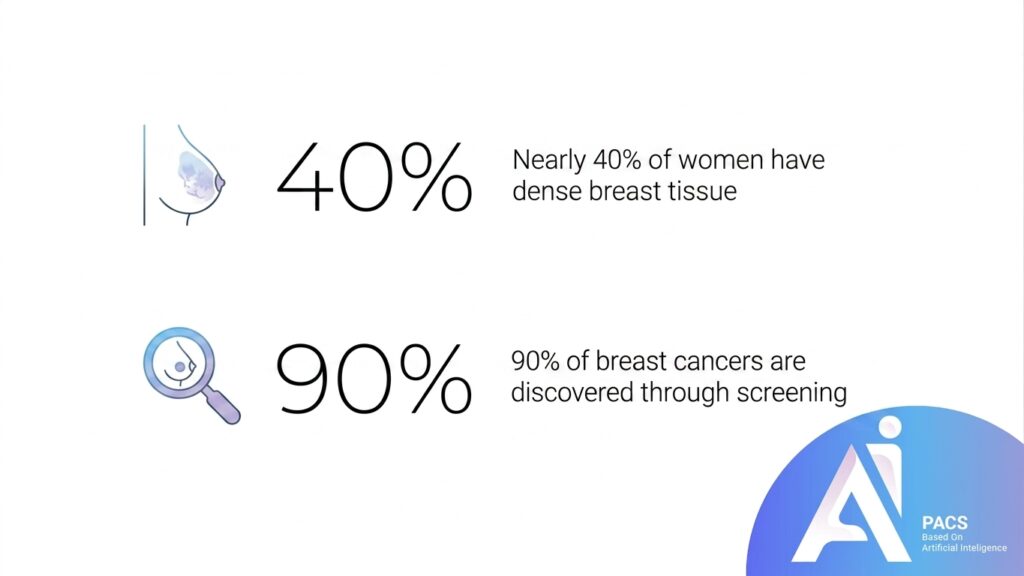
Categories C and D are considered “dense breasts,” and together they apply to roughly 40 to 50 percent of women undergoing screening.
How Does Dense Breast Tissue Affect a Mammogram?
This is the heart of the matter. The challenge is rooted in a simple visual problem often called the “masking effect.”
The Masking Effect
On a mammogram, both dense breast tissue and many tumors appear white. Imagine trying to spot a white snowball against a snowy background versus against a dark sky. Against the dark sky (fatty tissue), the snowball stands out clearly. Against the snow (dense tissue), it becomes much harder to see. In the same way, a cancer can be camouflaged by surrounding dense tissue, making it more difficult for a radiologist to detect.
Reduced Sensitivity
Because of this masking effect, the sensitivity—or detection accuracy—of a standard mammogram is lower in dense breasts. Studies suggest that conventional 2D mammography may miss a notable proportion of cancers in women with extremely dense breasts, simply because the abnormality blends in.
Density as a Risk Factor
Separately, having dense breasts is also a mild, independent risk factor for developing breast cancer. So dense tissue presents a double consideration: it can make cancers harder to find, and it slightly raises the baseline risk. This is exactly why density information is so valuable for planning your screening.
If findings are complex, using AI PACs Mammogram Second Opinion Online Service can provide additional reassurance and expert review.
Categories of Breast Density
Understanding your BI-RADS category helps you and your physician make informed decisions:
- A (Almost entirely fatty): Mammograms are highly accurate here. Roughly 10% of women.
- B (Scattered density): Still largely reliable. About 40% of women.
- C (Heterogeneously dense): Some areas may obscure small masses. About 40% of women.
- D (Extremely dense): Highest masking effect and reduced sensitivity. About 10% of women.
Categories C and D are the ones that typically prompt a conversation about supplemental screening.
Symptoms and Warning Signs
It’s important to understand that dense breast tissue itself causes no symptoms. You cannot feel it, and it does not cause pain, lumps, or changes you can detect at home. It is purely a radiological finding.
However, you should always remain attentive to general breast-health warning signs and report any of the following to your physician promptly:
- A new lump or thickening in the breast or underarm
- Changes in breast size or shape
- Skin dimpling, puckering, or redness
- Nipple changes, inversion, or unusual discharge
- Persistent, localized breast pain
These signs warrant evaluation regardless of your breast density.
Diagnosis & Testing
Breast density is determined directly from your screening mammogram by a radiologist. In many regions, density notification laws now require that your report include your density category, so you may see it stated explicitly.
Standard Mammography
A traditional 2D mammogram remains the foundation of breast cancer screening for all women. Preparation is straightforward: avoid using deodorant, lotion, or powder on the day of the exam, as these can interfere with the images. Wear a two-piece outfit for convenience, and let the technologist know if there’s any chance you could be pregnant.
3D Mammography (Tomosynthesis)
3D mammography takes multiple thin image “slices” of the breast, allowing the radiologist to scroll through the tissue layer by layer. This reduces the masking effect and improves cancer detection in dense breasts compared with 2D imaging alone.
Supplemental Imaging
For women with dense breasts, physicians may recommend additional tests:
- Breast ultrasound: Uses sound waves and can detect cancers hidden in dense tissue. No radiation involved.
- Breast MRI: The most sensitive method, often reserved for high-risk patients.
- Contrast-enhanced mammography: An emerging option that highlights areas of increased blood flow.
What to expect is generally simple and non-invasive—most supplemental tests are painless and take 15 to 45 minutes.
Treatment Options
It’s worth clarifying that dense breast tissue is not a disease and does not require treatment. There is no medication or procedure to “reduce” density for health reasons, and you do not need to change anything about your body. The focus is entirely on appropriate screening.
Personalized Screening Plans
The main “intervention” is a tailored screening strategy. Your physician will weigh your density category, family history, age, and other risk factors to recommend how often to screen and which tests to use.
Risk Assessment Tools
For some women, a formal breast cancer risk assessment helps determine whether MRI or other enhanced screening is warranted. This is a collaborative, reassuring conversation rather than a cause for alarm.
Lifestyle Support
While lifestyle changes don’t alter breast density directly, maintaining a healthy weight, limiting alcohol, staying physically active, and avoiding smoking all support overall breast health and may modestly influence risk.
Practical Tips for Patients
- Know your density category. Ask your physician or check your mammogram report for your BI-RADS letter.
- Keep screening consistent. Even with reduced sensitivity, regular mammograms remain one of the best tools for early detection.
- Discuss supplemental imaging. If you’re in category C or D, ask whether ultrasound or MRI would benefit you.
- Stay consistent with the same facility when possible, so radiologists can compare images year over year.
- Prepare properly: skip deodorants and lotions on exam day, and schedule when your breasts are least tender.
- Track your family history and share updates with your care team.
- Don’t panic over a “dense” result—it’s common, normal, and manageable with the right plan.
Latest Scientific Findings
Research over the past several years has strengthened our understanding of breast density and screening:
- According to a 2022 study published in Radiology, adding tomosynthesis (3D mammography) to screening improved cancer detection rates in women with dense breasts while reducing false-positive recalls compared with 2D mammography alone.
- A 2019–2020 trial known as the DENSE trial, published in the New England Journal of Medicine, found that supplemental MRI screening in women with extremely dense breasts significantly reduced the rate of interval cancers (cancers found between regular screenings).
- A 2021 review in JAMA highlighted that breast density is both a masking factor and an independent risk factor, reinforcing the value of personalized screening discussions.
- A 2023 study in The Lancet Oncology examined contrast-enhanced and abbreviated MRI protocols, suggesting these may offer faster, more accessible supplemental screening options for dense-breast patients in the future.
- Research summarized by the National Cancer Institute (NIH) continues to confirm that combining modalities improves early detection in dense breasts, supporting a multi-tool approach.
science is steadily improving how we detect cancer in dense tissue, giving you more and better options than ever before.
Conclusion
Dense breast tissue can affect mammogram results by making it harder to spot abnormalities, but this is a well-understood and manageable situation—not a reason for fear. Breast density is normal, common, and simply one piece of your overall health picture. The key is knowledge: understanding your density category empowers you and your physician to choose the most effective screening approach for you.
If your mammogram report mentions dense breasts, take it as an invitation to start a helpful conversation rather than a cause for worry. Ask about supplemental imaging, stay consistent with your screenings, and keep your care team informed about your history. With the right plan in place, you can feel confident and proactive about protecting your breast health for years to come.
Scientific References
- American College of Radiology. ACR BI-RADS Atlas: Breast Imaging Reporting and Data System. 5th ed. 2013. https://www.acr.org/Clinical-Resources/BI-RADS
- Bakker MF, et al. “Supplemental MRI Screening for Women with Extremely Dense Breast Tissue (DENSE Trial).” New England Journal of Medicine. 2019;381:2091–2102. DOI:10.1056/NEJMoa1903986
- Boyd NF, et al. “Mammographic Density and the Risk and Detection of Breast Cancer.” New England Journal of Medicine. 2007;356:227–236. DOI:10.1056/NEJMoa062790
- National Cancer Institute. “Dense Breasts: Answers to Commonly Asked Questions.” NIH. https://www.cancer.gov/types/breast/breast-changes/dense-breasts
- U.S. Food and Drug Administration. “Mammography: What You Need to Know.” FDA. 2023. https://www.fda.gov/radiation-emitting-products/mammography
- RadiologyInfo.org. “Dense Breast Tissue.” RSNA & ACR. https://www.radiologyinfo.org/en/info/dense-breasts
- Mayo Clinic Staff. “Dense Breast Tissue: What It Means to Have Dense Breasts.” Mayo Clinic. https://www.mayoclinic.org/tests-procedures/mammogram/in-depth/dense-breast-tissue/art-20123968
- Cleveland Clinic. “Dense Breast Tissue.” https://my.clevelandclinic.org/health/diseases/22890-dense-breasts
- Sprague BL, et al. “Prevalence of Mammographically Dense Breasts in the United States.” Journal of the National Cancer Institute. 2014;106(10):dju255. DOI:10.1093/jnci/dju255
- Hooley RJ, et al. “Breast Ultrasonography: State of the Art.” Radiology. 2013;268(3):642–659. DOI:10.1148/radiol.13121606
- Comstock CE, et al. “Comparison of Abbreviated Breast MRI vs Digital Breast Tomosynthesis for Breast Cancer Detection in Women With Dense Breasts.” JAMA. 2020;323(8):746–756. DOI:10.1001/jama.2020.0572
- MedlinePlus. “Mammography.” U.S. National Library of Medicine. https://medlineplus.gov/mammography.html