
Why an MRI Second Opinion Matters?
A magnetic resonance imaging (MRI) scan is one of the most powerful diagnostic tools in modern medicine — but its value depends entirely on how it is interpreted. Two radiologists reading the same MRI can reach different conclusions, and those differences can change your treatment path entirely.
The evidence is striking. Peer-reviewed research consistently shows that expert second reads change findings — and sometimes treatment.
DISCREPANCY RATE
of body MRI interpretations contain at least one discrepancy when reviewed by a subspecialty radiologist.
Source: American Journal of Roentgenology
REPORT CHANGES
of MRI reports are modified after a second expert review — sometimes changing surgical or treatment decisions.
Source: Published radiology research
GROWING DEMAND
Second opinion requests on MRI studies across U.S. medical centers grew over a 13-year period.
Source: U.S. medical center data
An MRI second opinion isn't distrust — it's safer medicine. It confirms what's correct, catches what may have been missed, and clarifies ambiguous language before major clinical decisions are made.
When you should request an MRI second opinion
Not every MRI requires a second look. But for the following situations, an independent expert review can be one of the most important decisions you make.
Five situations where a second read changes outcomes.
Based on radiology evidence and the cases physicians most often escalate.
Before major surgery
If your MRI is being used for spine surgery, brain surgery, joint replacement, or any high-risk procedure, an independent confirmation is one of the highest-value uses of a second opinion. A small change in interpretation can mean the difference between invasive surgery and conservative management.
After a cancer diagnosis or suspected tumor
When an MRI suggests a mass, lesion, or possible malignancy, accuracy is critical. A subspecialty radiologist can assess tumor characteristics, surrounding involvement, and staging implications more precisely than a general radiologist.
When the report is inconclusive or ambiguous
Phrases such as:
"signal abnormality of uncertain significance"
"clinical correlation recommended"
"borderline finding"
"non-specific changes"
leave both patients and physicians without a clear path forward. A second opinion replaces ambiguity with a structured, actionable interpretation.
Persistent symptoms despite a "normal" MRI
If your scan was read as normal but your symptoms continue, a second review may identify findings that were initially overlooked — particularly in complex regions like the brain stem, cervical spine, sacroiliac joints, or pelvic structures.
When two doctors disagree on the MRI
If your referring physician and another specialist interpret the same MRI differently, an independent third reading by a board-certified radiologist can resolve the conflict and support a clear treatment decision.
Who Reviews Your MRI Images?
Every MRI second-opinion review is performed by an experienced, board-certified radiologist — not generated automatically and not reviewed by non-medical personnel.
In addition to clinical experience, our radiologists have completed advanced international training courses in MRI interpretation, ensuring their reviews align with globally recognized imaging standards.

Dr. Bahareh Mobasheri
Board-Certified Radiologist
Experienced in interpreting a wide range of MRI examinations, including structural abnormalities, inflammatory processes, and incidental imaging findings.
Completed advanced international MRI training programs.
Subspecialty focus: Breast MRI
Cases reviewed: +1,000 MRI studies
Medical Council No: 133284

Dr. Vahid Alizadeh
Board-Certified Radiologist
Extensive experience reviewing complex MRI cases and providing independent second-opinion assessments.
Completed advanced international MRI training programs.
Subspecialty focus: Cardiac MRI
Cases reviewed: +5,000 MRI studies
Member of the European Society of Radiology (ESR)
ESR ID: 160956

Dr. Reza Alizadeh
Board-Certified Radiologist
Long-standing experience interpreting MRI examinations across multiple anatomical regions, with strong emphasis on correlating imaging findings with clinical history.
Completed advanced international MRI training programs.
Subspecialty focus: Brain MRI
Cases reviewed: +10,000 MRI studies
40 Years of Diagnostic Excellence
How the AI-PACS MRI second opinion process works
A simple, secure, four-step process — designed for patients, referring physicians, and international clients.
⏱ Under 24h turnaround
🔒 End-to-end encrypted
🌐 Available worldwide
01
Upload your MRI images (or send via WhatsApp)
Securely upload your MRI study in DICOM format through our encrypted platform. If you have your images on a CD, DVD, or USB drive from your imaging center, we provide step-by-step instructions for extracting the files. For patients in regions where uploading is difficult, WhatsApp submission is also accepted.
📄 Need help with DICOM files? Read our upload guide →
02
Initial image review & transparent cost confirmation
A radiologist performs a quick initial review to confirm that the images are complete and of sufficient quality for interpretation. You then receive a clear timeline and a confirmed fixed price — typically within 1–2 hours of upload.
✓ No hidden fees · No surprises
03
Secure payment via PayPal
Complete payment securely through PayPal — the world's most trusted online payment platform, accepted in 200+ countries and supporting multiple currencies. Every transaction is protected by PayPal's buyer protection, so you can pay with confidence from anywhere in the world.
04
Expert report delivered in under 24 hours
You receive a detailed written second-opinion report signed by the reviewing radiologist. The report includes findings, clinical impression, and clarification of any ambiguous terminology. After delivery, you may ask follow-up questions to better understand the findings or discuss next steps.
⏱
TYPICAL TURNAROUND
Routine review: under 24 hours after payment, with complete, readable DICOM images available. Fast Track: under 1 hour for suitable time-sensitive cases.
OUR SERVICE GUARANTEE
We make two concrete promises on every MRI second opinion:
1️⃣ Routine report delivery: under 24 hours after payment, once complete, readable DICOM images are available. Fast Track review is available in under 1 hour for suitable time-sensitive cases. AI-PACS is not an emergency care service.
2️⃣ Physician-reviewed and signed report: the physician reviews the images and is responsible for the final report. Your PDF includes the physician’s name and signature, and you can ask questions through our dedicated chat.
Types of MRI studies we review
We match every case to a radiologist with experience in the relevant anatomical region. Subspecialty matching is one of the most important factors in reducing diagnostic error — research consistently shows that subspecialist interpretation improves accuracy for complex MRI studies.
✓ Brain MRI second opinion
Independent review of brain MRI for headache, neurological symptoms, suspected stroke, multiple sclerosis, tumors, vascular anomalies, and post-treatment follow-up.
✓ Spine MRI second opinion
Detailed review of cervical, thoracic, or lumbar spine MRI studies — including disc disease, nerve impingement, spinal cord findings, post-surgical evaluation, and pre-operative confirmation.
✓ Cardiac MRI second opinion
Expert interpretation of cardiac MRI for evaluation of cardiomyopathy, congenital heart conditions, post-infarction assessment, and inflammatory cardiac disease.
✓ Neck MRI second opinion
Review of soft tissue, vascular, and lymphatic structures of the neck region, including suspicious masses and post-treatment follow-up.
✓ Joint & musculoskeletal MRI
Independent review of knee, shoulder, hip, ankle, and wrist MRI to clarify findings before treatment discussions. Share your DICOM images, any existing report, symptoms, and relevant earlier scans. For postoperative studies, include the surgery type and date. You receive a written opinion and can ask questions afterward.
✓ Abdominal & pelvic MRI
Independent interpretation of liver, kidney, pancreas, gynecologic, and pelvic imaging — including evaluation of incidental findings and characterization of suspicious lesions.
✓ Breast cancer second opinion
Comprehensive review of breast MRI, mammography, and ultrasound — particularly for high-risk patients, BI-RADS 3/4 lesions, and pre-treatment confirmation.
Don't see your study type?
We also review specialty MRI studies on a case-by-case basis. Contact us with your study details for a custom evaluation.
How much does an MRI second opinion cost?
Transparent, fixed pricing — confirmed before any review begins. No hidden fees, no surprises.
✓ Up to 10× more affordable than U.S. average
INDUSTRY CONTEXT
A 2020 study published in Surgical Neurology International reported that the mean cost of a second opinion consultation in the United States is $493, ranging from $90 to $1,300 depending on case complexity and provider. AI-PACS keeps expert second opinions accessible globally — starting from just 49 €.
Does insurance cover MRI second opinions?
Coverage varies by insurer and country. Our services are typically self-pay, but many patients submit our written reports to their insurance for partial reimbursement — particularly when the second opinion influences a surgical or treatment decision. We provide itemized documentation upon request.
AI vs Human Radiologist: Why Both Matter at AI-PACS
AI-Only Review
Human Radiologist Only
AI-PACS Approach
Speed
Very fast
Standard
Fast + Accurate
Detection of subtle findings
Variable
Excellent (subspecialty)
Excellent
Clinical context integration
Limited
Strong
Strong
Legally defensible report
❌
✅
✅
Suitable for major decisions
❌
✅
✅
At AI-PACS, all final reports are written and signed by a board-certified radiologist. AI tools are used to support workflow, image enhancement, and consistency — but never to replace the clinical judgment of a trained physician. This is the standard our team has followed since AI-PACS was founded, and we believe it is the only responsible approach for diagnostic medicine today.
What's Included in Your Second Opinion Report
Every report delivered by AI-PACS includes:
✓ Full re-interpretation of all available MRI sequences
✓ Clear findings section in structured radiology format
✓ Clinical impression with direct comparison to original report (where provided)
✓ Plain-language explanation of complex terms (on request)
✓ Recommendations for next steps when applicable
✓ Signed and credentialed by the reviewing radiologist
A second opinion on your MRI results
Your report may leave a question unanswered, describe findings that do not seem to fit other medical information, or give a conclusion you would like clarified. Tell us what concerns you and which questions you want the review to address.
Share your complete images in DICOM format and relevant medical history. We usually do not ask for the original report before the independent image review.
Your questions might include:
- “What do my MRI findings mean in relation to the question my doctor is investigating?”
- “Which findings are clear, and which remain uncertain?”
- “How does this MRI compare with my earlier examinations?”
The written opinion explains the findings in the context of the information you provide, including what the images can and cannot establish. It may agree with the earlier interpretation; a different diagnosis is not a promised outcome.
Comparing your current and previous MRI scans
“I have had MRI scans at different centers over several years. How does the latest scan compare with the earlier ones?”
An independent MRI second opinion can consider the latest findings alongside relevant earlier examinations. Tell us which finding or question you want the comparison to address.
For an Advanced Consultation, provide:
- Complete available MRI studies in DICOM format, with their examination dates.
- The questions you want answered about changes or similarities between the scans.
- Relevant medical records and treatment or surgery dates, when applicable.
When the studies are suitable for comparison, the written opinion can summarize relevant imaging changes and explain how earlier findings relate to the latest examination. Missing images, different sequences or differences in image quality may limit the comparison. The team confirms the review scope after checking the supplied material.
The findings can support discussion with your treating clinician about your condition or response to treatment. Imaging alone does not determine treatment success or the next treatment decision.
What you receive from an MRI second opinion
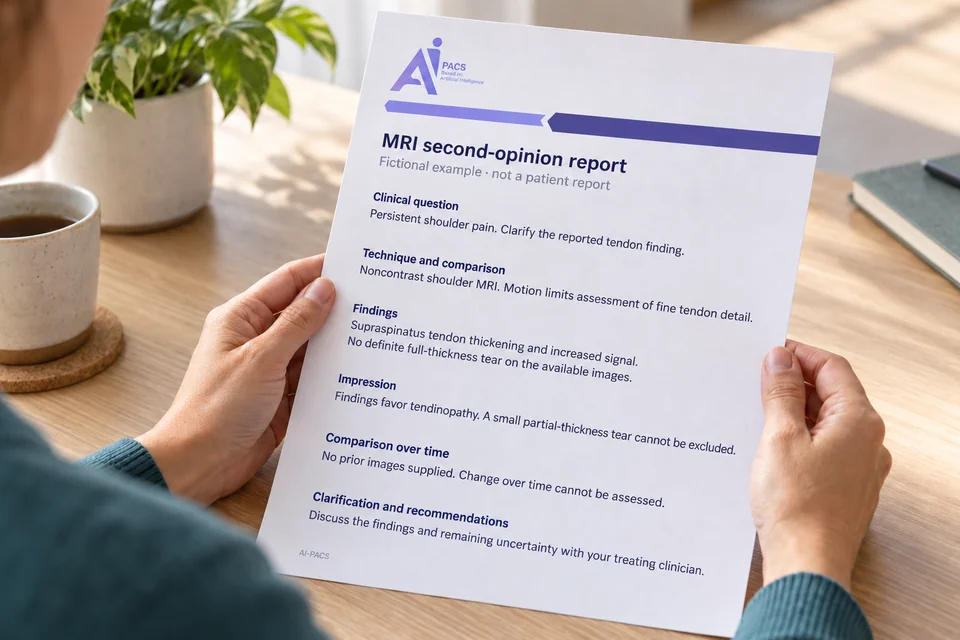
You receive a signed, written opinion based on an independent review of your MRI images. It explains the relevant findings, what they may mean and what remains uncertain. The fictional example below shows how a report can address a patient’s question; your own report is based on your images and clinical information.
Inside your written opinion · 1 of 6
Why this MRI is being reviewed
In this fictional example: Persistent shoulder pain. Clarify the reported tendon finding.
Your question gives the review a purpose. Relevant clinical information helps the radiologist interpret the images in context.
Inside your written opinion · 2 of 6
What was available for review
In this fictional example: Noncontrast shoulder MRI. Motion limits assessment of fine tendon detail.
The report identifies the material reviewed. Missing images, motion or differences between examinations can limit an assessment or comparison.
Inside your written opinion · 3 of 6
What the images show
In this fictional example: Supraspinatus tendon thickening and increased signal. No definite full-thickness tear on the available images.
Findings describe visible observations, including relevant abnormalities and structures without a definite abnormality. Here, the supraspinatus is one of the shoulder’s rotator cuff tendons. “No definite full-thickness tear” describes what was not identified on the supplied images; it does not rule out every tendon injury.
Inside your written opinion · 4 of 6
What the findings mean together
In this fictional example: Findings favor tendinopathy. A small partial-thickness tear cannot be excluded.
The impression summarizes the important findings and the radiologist’s interpretation. In this example, tendinopathy means a tendon abnormality; the wording also makes the remaining uncertainty clear. A second opinion may agree with the original report.
Inside your written opinion · 5 of 6
How earlier scans add context
In this fictional example: No prior images supplied. Change over time cannot be assessed.
A comparison can explain how relevant findings relate across the supplied examinations. Different techniques or missing studies may limit what can be concluded.
Inside your written opinion · 6 of 6
What to discuss next
In this fictional example: Discuss the findings and remaining uncertainty with your treating clinician.
After delivery, you can ask questions about the findings or wording in your AI-PACS conversation. If you need help understanding a difference from the original report, share it for clarification. Medical questions are referred to a doctor; treatment decisions remain with your treating clinician.
An independent review starts with your complete DICOM images and the questions you want clarified. Earlier studies can provide context when suitable for comparison.
Request an MRI second opinionThis fictional example illustrates the written opinion you can receive. It is not a patient report, a diagnosis for the reader or a promised outcome. Report sections vary with the examination and review scope.
What If the Two Opinions Disagree?
This is one of the most common questions we receive — and it has a straightforward answer.
If our second opinion differs from your original report, the next step is not to choose between them, but to share both reports with your treating physician. In most cases, your doctor will:
1
Review both interpretations side by side
2
Correlate findings with your symptoms and clinical history
3
Decide whether additional imaging, a biopsy, or a third opinion is appropriate
A meaningful disagreement does not necessarily mean either radiologist was wrong — MRI interpretation involves judgment, and second opinions exist precisely to surface those nuances. In many cases, disagreement is what saves patients from unnecessary surgery or missed diagnoses.
💡 Key insight: Disagreement is what saves patients from unnecessary surgery or missed diagnoses.