
Why Lumbar Spine Fractures Often Go Undiagnosed: The Importance of Timely MRI and Second Opinions
Lumbar spine fractures, particularly in older adults, are a common but often underdiagnosed medical issue. These injuries can result from trauma, osteoporosis, or even minor strain in weakened bones. Accurate and timely imaging plays a vital role in diagnosing these fractures early, helping to prevent long-term complications like chronic pain, spinal deformity, or nerve damage.

A Patient’s Journey
A Misstep That Could Have Been Missed:
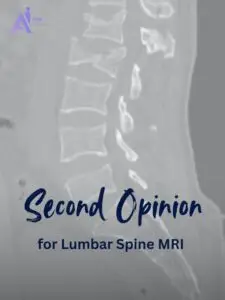
A 72-year-old woman with known osteoporosis slipped while walking at home. She developed mild back pain, which she dismissed as a muscle strain. However, after several weeks of ongoing discomfort, her physician ordered an X-ray, which showed a slight vertebral collapse. An MRI confirmed an acute compression fracture at the L1 level. Since it was a recent and stable injury, she was treated conservatively and made a full recovery. Without imaging, this fracture might have gone undiagnosed and worsened over time.
Questions about your spine MRI?
- Who reads it: a team of three physicians led by one of our named radiologists, including a specialist relevant to your case.
- What you receive: a signed written report, plus answers to your questions in your private AI-PACS conversation.
- Time and price: Basic €49 or Advanced €99, confirmed before you pay; usually within 24 hours after payment. Fast Track +€49 for suitable time-sensitive cases.
- What you need: your DICOM images and your questions — a written report is optional.
Start my consultation (1–2 min)
Prefer to read first? See how our spine MRI second opinion works. This service does not replace emergency care.
Why Is Lumbar Spine Fracture MRI Important?
Differentiating Between Old and New Injuries
X-rays can identify obvious fractures but may miss early or subtle breaks.
MRI detects bone marrow edema and helps distinguish acute from chronic fractures.
CT scans provide detailed views of bones, which are especially useful in surgical planning.
Specialized MRI Techniques for Complex Cases
In some instances, particularly when differentiating between pathological (e.g., metastatic) and non-pathological fractures, additional MRI techniques can be highly valuable:
Out-of-phase imaging (In/Out Phase): Useful for identifying loss of fat signal in bone marrow. Pathological fractures often show reduced signal due to marrow replacement by tumor cells.
DWI (Diffusion-Weighted Imaging): Highlights restricted diffusion common in malignancies, aiding distinction from benign compression fractures.
Post-contrast MRI (with Gadolinium): Enhances soft tissue structures and helps detect epidural extension or associated soft tissue masses.
Common Triggers for Lumbar Fractures:
Osteoporosis: makes bones fragile and easily fractured
Falls or trauma, even low-energy, in older adults
Metastatic disease: cancer weakening the spinal bones
Imaging Helps To:
Confirm the presence and extent of the fracture
Identify if the fracture is stable or unstable
Guide decisions on whether conservative care or surgery is needed
Distinguish between benign fractures and malignant or infectious causes
When to Get a Lumbar Spine Fracture MRI and Second Opinion
Imaging Is Urgently Needed If You Experience:
Sudden back pain after a fall, particularly in the elderly
Pain that worsens with movement or standing
A history of osteoporosis or long-term steroid use
New back pain in someone with a history of cancer
Imaging Can Be Delayed or Repeated If:
The pain is chronic and not linked to a specific injury
Doctors are monitoring the healing of a known fracture
Reassessment is needed for treatment progress
Who Needs Lumbar Spine Fracture Imaging and Expert Review?
High-Risk Groups Include:
Adults over 65 reporting new back pain
People with diagnosed osteoporosis
Patients on medications that weaken bones (like steroids)
Those experiencing height loss or spine curvature changes
Important Differential Diagnoses to Consider:
Metastatic lesions vs. osteoporotic fractures
Infectious spondylodiscitis: may compress the spinal canal and require emergency intervention
Primary bone tumors: CT and MRI help identify characteristics of these rare but serious conditions
Experts Involved in Your Care:
Primary care providers for initial assessment
Radiologists for interpreting X-rays, MRIs, or CT scans
Orthopedic and spine surgeons for complex or unstable fractures
Neurosurgeons for urgent spinal cord compression

AI-PACS Is With You
Not all spinal fractures are immediately visible or correctly diagnosed. That’s why a second opinion can be so valuable.
At AI-PACS.com, our specialized radiologists provide thorough reviews of lumbar imaging, including:
Identifying whether a fracture is recent or old
Evaluating stability and the need for surgery
Advising on the appropriate follow-up imaging schedule
Reviewing complex findings like suspected metastases or infection
Why a Second Opinion Matters
Sometimes, determining whether a fracture is due to cancer, infection, or simply osteoporosis is complicated. These distinctions can drastically change treatment decisions. Our radiologists specialize in reading subtle imaging features and provide clarity when it matters most.
Additionally, even when imaging is done promptly, there are cases where interpretation delays or misread findings lead to postponed treatment. Unfortunately, this can result in long-term complications or loss of function. A second opinion from an expert ensures that such risks are minimized and appropriate care is delivered without delay.
Get your scan reviewed by an expert today with our AI-PACS online radiology report services.
Final Thoughts
Lumbar spine fractures are more common than many realize, especially in seniors with weakened bones. Early diagnosis can significantly impact the recovery process.
Advanced imaging techniques, such as in-phase/out-of-phase imaging, diffusion-weighted imaging (DWI), and contrast-enhanced MRI, can help distinguish complex or pathological fractures from more typical osteoporotic injuries.
If you or someone you care about is dealing with unexplained back pain or recent trauma, don’t hesitate—getting the proper scan at the right time can prevent unnecessary suffering and long-term issues. Consider a lumbar spine fracture MRI second opinion from AI-PACS for reassurance and optimal care.
Reference:
Medscape
Radiopaedia