
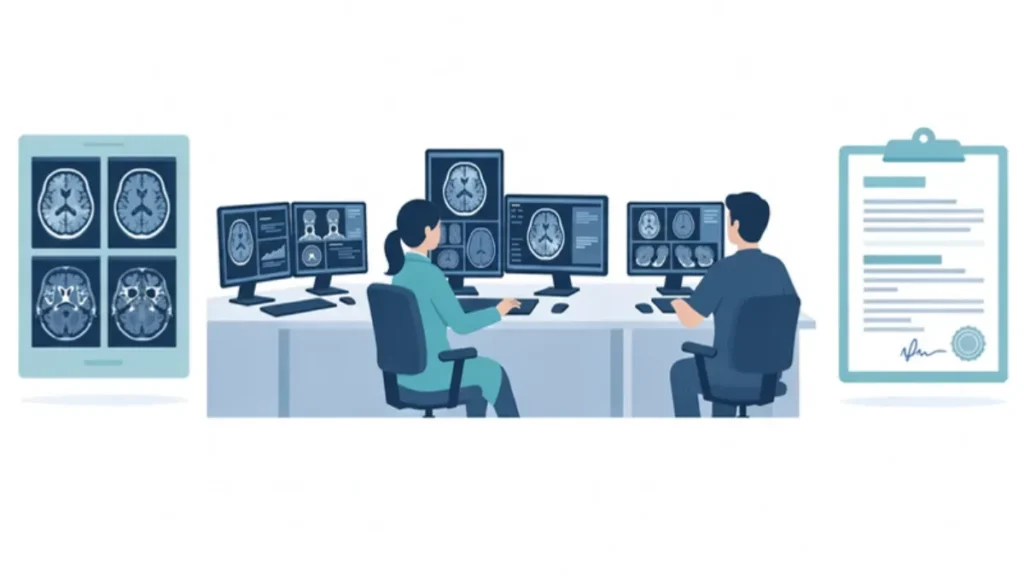
Your MRI report is in your hands. Something about it doesn’t sit right. Maybe it doesn’t match how you feel. Maybe a big decision now depends on it.
So you wonder: can an MRI be wrong? Yes, sometimes. Here is how often, why it happens, and when a second opinion helps.
The short answer: Yes, an MRI can be wrong, but the scanner is rarely the problem. The reading is. A report can miss your history, skip a comparison with older scans, or come from a reader outside the right subspecialty. When the result will change what happens next, a second opinion is worth it.
Can an MRI be wrong?
The scanner rarely gets it wrong. The reading can still be incomplete.
A report is one radiologist’s interpretation. It is often written fast, sometimes without your history. And the reader may not specialise in your part of the body.
Most reports are accurate. But imaging is interpretation, not a lab value. Many findings sit in a grey zone, where two careful experts can weigh them differently.
Errors go both ways. A false negative misses something real. A false positive calls something abnormal that isn’t, or makes it sound worse than it is. Both can change your treatment.
How often are MRI results wrong?
There is no single number. But research shows how much a specialist read can change. In one study, subspecialists re-read 2,326 musculoskeletal CT and MRI scans. About 26% of second reads differed in a way likely to change treatment. In cancer cases it was 36% (AJR, 2016).
That does not mean one report in four is wrong. These scans were already sent for a second look, often because something was unclear. The study also found that most differences were in interpreting findings, not in spotting them.
Unsure about your MRI or CT report?
- Who reads it: a team of three physicians led by one of our named radiologists, including a specialist relevant to your scan.
- What you receive: a signed written report, plus answers to your questions in your private AI-PACS conversation.
- Time and price: Basic €49 or Advanced €99, confirmed before you pay; usually within 24 hours after payment. Fast Track +€49 for suitable time-sensitive cases.
- What you need: your DICOM images and your questions — a written report is optional.
Why can a radiologist read an MRI wrong?
Radiologists are careful doctors. Most misreads come from what the reader didn’t have, not from carelessness.
The report was written without your history
A report is only as good as the information behind it. Often the radiologist never saw your symptoms or your earlier treatment.
Or things moved on after the report. New blood tests. A biopsy result. A treatment that worked, or didn’t. Now you need to know two things. Does the first reading still hold? And should you stay on this path or change it?
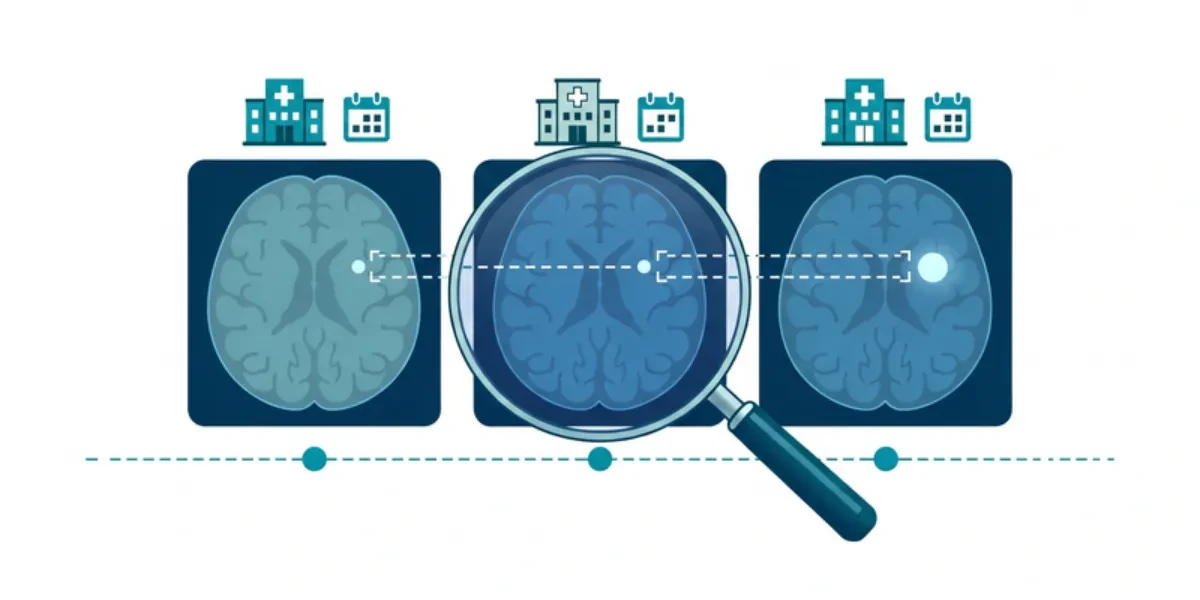
Nobody compared your older scans
This is one of the most common gaps we see. An MRI at one centre last year. A CT at another this spring. A new scan today.
The centre that did today’s scan often can’t see the older studies. Or its workflow has no step for comparing them. Yet change over time is often the key fact. Is a spot new, stable for two years, or growing?
The right subspecialist wasn’t there
Medicine is rarely two plus two. A lesion can be “indeterminate”. A tear can be borderline. A change “may represent” two different things.
These are the reports where subspecialty experience matters most. Yet that expert may not work at your centre. Or they may be too busy to give one case real time.
Can an MRI or CT scan miss cancer?
It can. And in cancer, imaging is not a one-off diagnosis. Two people with the “same” colon cancer can behave very differently. Treatment is becoming more and more individual.
So each scan needs context: the pathology, the treatment given, how the tumour looked before, and which changes are expected after treatment. Telling treatment effect from active disease is one of the hardest calls in radiology.
Cancer is also where many of our requests come from. The scan depends on the cancer.
Can a prostate MRI be wrong?
Prostate MRI is usually scored with PI-RADS. The score is a reader’s judgement, and borderline scores are where a second read matters most. See how to read a prostate MRI report.
Breast: mammogram, ultrasound and breast MRI
Many breast cancers are first found on a mammogram, including 3D mammography (tomosynthesis). Breast ultrasound and breast MRI often follow. Before a biopsy, a second look at these images is always worth it.
Lung and abdomen: CT for diagnosis and staging
Lung cancer is found and followed on chest CT. Bowel and stomach cancers are staged on CT of the abdomen and pelvis. Here, comparison with earlier scans is often the key.
Cancer imaging is one of the areas our team works in.
Can a brain MRI be wrong?
The brain is where MRI matters most. Almost every brain question starts with an MRI, and MRI changed neuroimaging completely.
That is also why brain scans are among the second opinions we are asked for most. A small finding can mean very different things, depending on your age, your symptoms and your earlier scans. A brain MRI second opinion puts your scan in front of a neuroradiologist.
Can a knee MRI be wrong?
In bones and joints, the picture alone can mislead.
One person has a large ACL tear on MRI, yet the knee is stable. Another has only a few small injuries, yet the knee gives way.
A report that only describes the image can push the decision the wrong way, towards surgery or away from it. A musculoskeletal second opinion links the findings to your symptoms, your examination and how healing is going. To understand the wording first, see how to read your knee MRI report.
When should you get a second opinion on your MRI?
Get one when the answer will change what happens next:
- Before a biopsy, surgery or any invasive step. Before anything invasive, it is always better to hear more than one opinion. It is worth it even before a non-invasive treatment.
- When a decision can’t wait for a late report. A second read can run alongside the original report. Fast Track takes under 1 hour, with the same team of three.
- When your situation changed after the report. New tests, a biopsy or a new treatment.
- When the report doesn’t match how you feel.
Severe or worsening symptoms? Go to an emergency department. A remote second opinion is not emergency care.
How is the AI-PACS second opinion different?
Most second-opinion services give your case to one doctor. We don’t.
Three radiologists review your images. At least one is an expert in your area: musculoskeletal, neuroradiology, cardiac MRI or cancer imaging.
Each one looks from a different angle. The images themselves, the comparison with earlier scans, and the clinical question you and your doctor are asking.
The team lead signs the final report. The team’s views are brought together into one clear written answer.
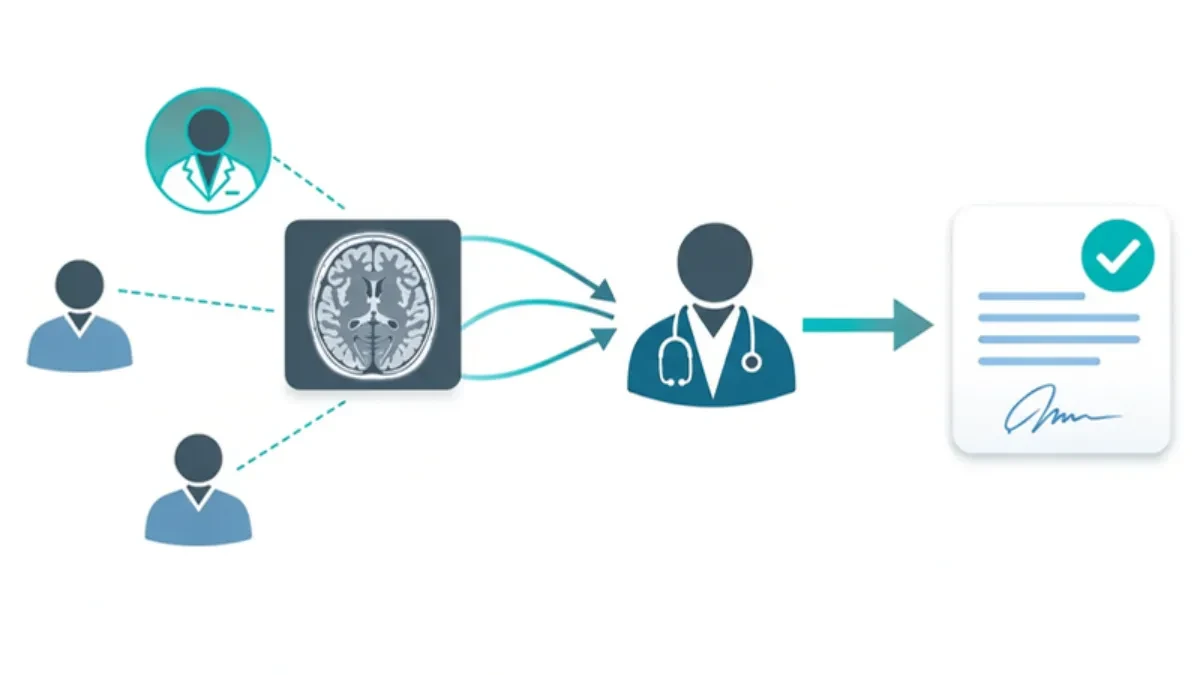
Three independent looks make a missed or over-called finding less likely. That is the whole point of a second opinion.
Our radiologists read the images themselves. AI does not read your scan. You can see who reviews your images and how.
When you probably don’t need a second opinion
- The report is clear and routine, it fits your symptoms, and your doctor has explained it.
- You only struggle with the medical words. Then a plain explanation of the report is the better step, not a second read.
- The scan itself was poor, or it was the wrong test. A new scan may be wiser. A second read can tell you this, but it can’t add what was never captured.
How to get a second opinion without a referral
You can do it from home, from any country. You don’t need a referral: you can send us your scan yourself. If your doctor prefers to refer you, that works too.
1. Get your images. Ask the imaging centre for your study in DICOM format, on a CD, a USB stick or a download link. The report alone is not enough, because we read the images. Our upload guide shows each step.
2. Add what the first reader may not have had. The original report, any earlier scans, and a few lines on your symptoms, surgery, biopsy or treatment.
3. Ask your real question. For example: “Does this tear need surgery?” or “Has this changed since last year?”
4. Get a signed written report. Share it with your doctor. You can also ask us follow-up questions about it.
How much does a second opinion cost?
| Study | Price |
|---|---|
| Plain X-ray | €12 |
| Basic: CT, MRI, mammogram or breast ultrasound, without contrast and without comparison | €49 |
| Advanced: contrast study, or comparison with earlier scans | €99 |
| Fast Track for suitable urgent cases (under 1 hour) | +€49 |
Comparing old and new scans, as in cancer follow-up, falls under Advanced, because the comparison is the real work. The price is confirmed before you pay.
Frequently asked questions
Can an MRI miss something?
Yes. A small finding can be overlooked, or read as harmless when it isn’t. A second read by a specialist, with your full history, lowers that risk.
How often are radiologists wrong?
There is no single figure. In one large study of musculoskeletal scans sent for a second read, about a quarter of reads differed in a way likely to change treatment.
Should I get a second opinion before a breast biopsy?
Yes. Before a biopsy or any invasive step, it is always better to have more than one radiologist look at the images.
Does insurance cover a second opinion?
It depends on your insurer. You pay us by PayPal, which issues an invoice for the service as a medical visit. Ask your insurer whether it reimburses it, and whether it requires a doctor in your own country.
Will my doctor mind if I get a second opinion?
Second opinions are a normal part of medicine. Most doctors welcome a specialist read on a hard case. You get a written report to share with them.
How long does a second opinion take?
Under 24 hours on the standard path. Under 1 hour with Fast Track, for suitable urgent cases. Both are reviewed by the same team of three.
Unsure about your MRI or CT report?
Send us your images and your question. Three radiologists review them, and the team lead signs your report, usually within 24 hours.
This article is general information, not a substitute for your own doctor’s advice. If you have severe or worsening symptoms, go to an emergency department.